

Women’s circle - The Intelligence of the Feminine
Marie Louise explores feminine and masculine energetics, women’s circles, embodiment and the relationship between individual expression, resonance and collective influence.
What becomes possible when women gather and give attention to the feminine qualities moving through them?
What a crackin' circle of goodness. There are moments in facilitation when you can almost feel a room change tone.
Bodies soften. Voices become more available. Movement emerges. Someone expresses something that gives another permission to feel something within herself. Laughter moves through the room. Vulnerability appears without needing to be fixed.
Something begins to hum. This is one of the things that fascinates me about women's circles.
Not simply women gathering to talk, but what becomes available when a group of human instruments come together and intentionally give attention to the energetics of the feminine.
Feminine Does Not Mean Female
This distinction matters. When I speak about feminine and masculine energetics, I am not using feminine as another word for woman or masculine as another word for man. I experience them as qualities or energetic architectures that can move through human beings irrespective of gender. Each of us carries our own composition. We may experience qualities associated with the feminine — receptivity, intuition, nurturing, creativity, sensuality, relational awareness, fluidity, feeling, collaboration, gestation and qualities associated with the masculine; direction, discernment, structure, focus, action, containment, protection, penetration, orientation.
These aren't rigid boxes. Nor do I see one as spiritually superior to the other. They are different qualities of expression and within each human instrument they can meet in unique proportions, forms and relationships.
The inquiry isn't:
Which one is better?
It is:
What is moving here? What has been given expression? What has been suppressed? What has become distorted? And what becomes possible when these qualities are brought into greater relationship and harmony?
The Female Body as an Instrument
There is another dimension to this that interests me. Although feminine energy is not exclusive to women, being born into and living through a female body creates a particular field of human experience.
Biology participates.
Genetics participate.
Hormonal rhythms participate.
Family history participates.
Culture participates.
Relationship participates.
The experiences held within and interpreted through the body participate.
So do generations of stories about what it means to inhabit a female body; what is acceptable, desirable, dangerous, powerful, shameful, beautiful, sexual, maternal, expressive or forbidden and through my own experiential and energetic lens, I am interested in the possibility that all of this contributes to the tone of the instrument. The body carries memory in many form, some we can describe biologically. Some psychologically. Some culturally and relationally and some I experience more subtly'; through sensation, resonance, energy and the ways the organism responds before the intellect has found language. I don't need all of these dimensions to be the same thing. I am interested in how they meet.
What Happens When the Instruments Gather?
Put one instrument in a room and it has its tone. Bring many instruments together and another phenomenon becomes possible.
Resonance.
This is where women's circles become particularly interesting to me. When female-bodied human beings gather with intention, there can be an opportunity to experience qualities of the feminine not simply as ideas, but as something tangible within the body and within the collective environment. One woman moves and another recognises something in herself. One woman allows vulnerability and another nervous system discovers that vulnerability can be met rather than rejected. Someone expresses pleasure without apology. Someone else recognises how long she has withheld hers. Someone receives instead of immediately giving. Someone speaks. Someone listens. Someone laughs loudly. Someone takes up space. Someone softens. The field changes and the individual instruments within it respond.
This is where the subjective and collective begin speaking to one another.
Beyond Competition
Women have not always experienced other women as safe. Competition, comparison, judgement, jealousy, exclusion and manipulation can become expressions within female relationships but, I don't see these as evidence of something inherently wrong with the feminine. They can be understood as dissonant expressions arising within human systems shaped by fear, scarcity, conditioning, protection and lived experience. A women's circle can provide another environment. Not one where everyone must agree. Not one where everything is soft and certainly not one where difficulty is spiritually bypassed in the name of “sisterhood.’ but an environment in which we can become curious about what happens when women give attention to support rather than comparison, collaboration rather than competition, expression rather than suppression, and curiosity rather than judgement.
Repeated experience matters, because what we experience within one environment can begin to influence what becomes available within us elsewhere.
Remembering Through the Body
There is something I find particularly beautiful about exploring feminine energetics through movement, breath, sound, sensation, creativity and relationship. We are no longer only discussing the feminine.
We are giving the organism an opportunity to experience it.
What does receiving feel like in my body?
What happens when I move without performing?
Can I experience sensuality without immediately relating it to sexuality or desirability?
What happens when I allow intuition to have a voice?
Can I nurture without abandoning myself?
Can I be fluid without losing direction?
Can I experience softness without equating it with weakness?
Can I receive support without needing to earn it?
These become experiential inquiries and perhaps something that has existed only as an intellectual concept begins to find its way into the physical instrument.
Understanding begins to marinate into lived experience.
The Feminine and Masculine in Relationship
The deeper inquiry, however, isn't about creating a world dominated by feminine energy. That would simply recreate imbalance in another direction. I am interested in harmonisation through our true nature.
The feminine and masculine can become extraordinarily generative when their different qualities are available to one another.
Structure can support creativity.
Direction can meet intuition.
Action can emerge from listening.
Containment can create conditions for surrender.
Discernment can protect what is tender.
Receptivity can reveal where action wants to move.
Neither disappears.
Neither dominates.
Each becomes more available to its own intelligence while participating in something larger and this inquiry belongs to all human beings, not only women.
From the Individual to the Collective
This brings me back to the question that runs through so much of my work:
What happens in the collective when something changes within the individual?
If a woman develops a different relationship with her own feminine expression, she doesn't leave that experience in the circle. She takes the instrument with her.
Into relationship.
Into family.
Into creativity.
Into sexuality.
Into parenting.
Into friendship.
Into leadership.
Into organisations.
Into community.
Likewise, when any human being gives attention to the relationship between masculine and feminine qualities within themselves, the expression they bring into their environment may change. The tone entering the field is different and when another instrument encounters that tone, something else may become possible.
This is the multidimensional nature of development that fascinates me.
Individual awareness becomes embodied expression.
Embodied expression enters relationship.
Relationship participates in environment.
Environment participates in the collective.
And the collective, in turn, continues to influence the individual. There is no neat beginning or end. There is relationship. There is resonance. There is harmonics. There is participation.
A Circle Is a Place to Practise
Perhaps this is one of the gifts of gathering. A women's circle doesn't need to provide an answer to what the divine feminine is. Perhaps defining it too rigidly would miss the point. Instead, it can create an environment in which we become curious about its qualities.
To move them.
Feel them.
Question them.
Express them.
Play with them.
Notice where they have become suppressed or distorted.
Notice where they are already beautifully alive and experience what happens when different expressions of the feminine are allowed to coexist in the same field.
Not to become more feminine.
Not to reject the masculine. Not to perform an idea of womanhood. But to become increasingly available to the unique composition of intelligence seeking expression through each of us. Perhaps that is where the real elevation occurs. Not feminine above masculine. Not woman above man but awareness elevating our capacity to recognise, harmonise and consciously express the many qualities already moving through the human instrument. when we do that together?
Well...
something begins to hum.
Continue the exploration
Essence Energetics®
Essence Energetics® explores the physical, emotional, psychological, energetic and spiritual dimensions of the human experience — becoming increasingly sensitive to the intelligence of life moving through us and the unique ways it seeks expression.

Level up or in
Marie Louise explores human development as a multidimensional process of maturity across body, mind, emotion, energy and consciousness, and asks how individual awareness participates in the collective.
Embark on a journey through the realms of consciousness, where each level offers a new vista of reality waiting to be explored. Where do you find yourself on this spectrum? Does your perception shift as you navigate through life's varied experiences?

Level Up or In?
What if human development is less a ladder of consciousness and more a multidimensional marination of maturity?
We have long been fascinated by the idea of levels.
Levels of consciousness. Levels of development. Higher states. Lower states. Awakening. Self-actualisation. Transcendence.
Abraham Maslow gave us one of the most recognisable maps of human motivation and development through what became known as the hierarchy of needs — moving through fundamental human needs towards self-actualisation, and in his later thinking, towards self-transcendence.
These maps can be useful.
They give the mind a way of comprehending something enormously complex. They offer us a vantage point from which to observe ourselves, recognise patterns and contemplate what else might be possible.
But a map is not the territory.
And I find myself increasingly curious about whether human development is adequately represented by a ladder at all.
What if we don't simply level up?
What if we level in?
Maturity Marinates
I have come to experience human development as something far less linear.
Maturity marinates. It takes place across multiple dimensions of the human experience, each continually informing and influencing the others.
Our genetics participate.
Our environment participates.
Our biology participates.
Our family and culture participate.
Our nervous system participates.
Our emotional experiences participate.
Our beliefs and conditioning participate.
Our relationships participate.
Our attention participates.
Our energetic experience participates.
Our spiritual inquiry participates.
And consciousness participates in our capacity to become aware of the whole extraordinary process. Rather than a series of neat developmental steps, I see something more like a living field of influence continually organising, adapting, responding and expressing itself through the human being.
Experience meets genetics.
Environment meets biology.
Conditioning meets awareness.
Relationship meets reflex.
Thought meets sensation.
The subjective meets the objective.
The individual meets the collective.
Consciousness meets form.
Somewhere within all of this, we mature. Not necessarily evenly, not necessarily predictably and certainly not in a straight line.
We Can Be Mature Here and Reflexive There
This multidimensional view helps explain something fascinating about being human. We can have extraordinary awareness in one area of our lives and find ourselves profoundly challenged in another. We may intellectually comprehend something for years and still discover that our body responds differently when the experience becomes personal. We may have expansive spiritual experiences and still encounter deeply conditioned emotional responses in relationship. We may demonstrate enormous professional intelligence and leadership while struggling to remain present with grief. We may understand the workings of the nervous system and still find ourselves in the middle of an automatic reaction before awareness catches up.
None of this necessarily represents failure or regression. It may simply reveal that different dimensions of us mature in different ways and at different times.
This is why I don't want to dismiss intellectual understanding in favour of embodiment, or embodiment in favour of spiritual experience, or scientific understanding in favour of intuitive knowing. I am interested in the relationship between them. Something can first be understood intellectually. Later experienced emotionally. Recognised physically. Encountered relationally. Perceived energetically. Contemplated spiritually and eventually something that we once knew becomes something we are increasingly able to live.
That is a very different idea of development.
The Human Sleeve
I sometimes call this multidimensional instrument our human sleeve.
The body, mind, emotions, nervous system, energy, senses, spirit and consciousness through which we experience and express life. We don't encounter reality independently of this instrument. We encounter life through an organism shaped by genetics, history, environment, experience, relationships, culture, memory, conditioning and the innumerable influences that have participated in our development and so our perception is not passive. The instrument participates in what is perceived. What one person experiences as possibility, another may experience as threat. What once contracted us may later become something we can remain present with. Something that was once completely outside our awareness may suddenly become visible. The external scene may not have changed at all, yet the internal organisation through which we experience it has.
A different experience of reality becomes available.
This is where consciousness becomes fascinating to me. Not simply as something we possess, achieve or elevate, but as the awareness through which we can begin to recognise the instrument itself and ability to express freely through it.
Subject. Object. Field. Awareness
There is another dimension to this inquiry. I am the subject of my experience and simultaneously, I become an object within yours. My body, words, actions, state, attention and expression enter your environment. Yours enter mine.
And when we come together, something else emerges: the field between us.
A relationship.
A family.
A room.
A community.
An organisation.
A culture.
A collective.
We influence these fields and are influenced by them.
Our nervous systems respond to one another. Behaviours are learned. Ideas travel. Language shapes perception. Emotional states can move through groups. Cultural patterns become normalised. Ways of responding can be passed from one generation to another and beyond what we can readily observe or measure, I remain interested in a larger conceptual and spiritual inquiry:
How does an individual shift in awareness participate in the consciousness of the collective?
I don't offer that as a conclusion. I offer it as a place from which to look.
The Hundredth Monkey and the Power of a Concept
There is a story often referred to as the hundredth monkey effect. In its popular telling, a new behaviour learned by a group of monkeys eventually reaches some critical threshold and somehow becomes available to monkeys elsewhere. The story has often been used to suggest the existence of a collective field of consciousness. As literal scientific evidence for such a mechanism, the popular version of the story does not hold up particularly well but I still find the concept interesting.
Because a concept does not need to masquerade as scientific proof to become a valuable lens for human inquiry. The hundredth monkey story invites me to contemplate:
What becomes possible within a collective when enough individuals begin perceiving, responding or behaving differently?
We already know through ordinary human experience that individual change does not remain entirely individual. A parent interrupts an inherited response and a child grows up inside a slightly different environment. One person refuses to participate in a familiar pattern and a relationship has to reorganise. Someone introduces a new idea and eventually an organisation speaks a different language. A generation questions something the previous generation accepted as normal and culture begins to move. One organism changes its expression. That expression enters the environment. The environment is now, however subtly, different. What happens next?
That question fascinates me.
Resonance as a Way of Listening
This is also where the language of resonance remains meaningful within my work. I experience the human being as having tone. Sometimes we feel coherent. Sometimes dissonant. Sometimes contracted. Sometimes expansive. Sometimes something resonates before we have language for why. We feel drawn towards something. Repelled by something. Opened. Closed. Energised. Quietened. Alive.
These experiences don't need to become a hierarchy of “high vibration” being good and “low vibration” being bad.
Dissonance itself may contain intelligence. A contraction may be communicating something. Fear may carry information. Grief may ask us to stop. Joy may show us something we hadn't been allowing ourselves to experience. Resonance, for me, becomes another way of listening to the instrument and experiential expression.
What is moving here?
What is this response communicating?
What am I resonating with?
What am I contributing?
What happens when awareness enters an automatic reflex?
And what becomes possible when the different dimensions of the organism begin to communicate more coherently?
Development Is Not an Escape From Humanity
This is where the idea of continually “leveling up” can become limiting. If higher always means better, we can inadvertently turn human development into another attempt to escape being human.
Move beyond the emotion. Transcend the body. Rise above the difficulty. Maintain the elevated state. But perhaps maturity sometimes moves in the opposite direction.
Down and in Into the body. Into the uncomfortable conversation. Into grief. Into pleasure. Into relationship. Into the unconscious response. Into the sensation beneath the story. Into the ordinary Tuesday afternoon when everything we thought we'd learned suddenly gets tested.
Spiritual expansion may open extraordinary dimensions of awareness. Intellectual comprehension can completely reorganise how we understand ourselves. Embodied experience can reveal something the intellect couldn't access through the tapping of experiential cognisance. Relationship can expose something meditation never touched.
Life can humble all of them.
Perhaps none needs to sit above another.
They are different dimensions and modes through which the human being can mature.
From Awareness to Expression
Utimately, I am interested in what awareness becomes when it enters life. If I experience an extraordinary state of consciousness but nothing changes in the way I relate, what has matured? If I understand compassion intellectually but cannot access it when someone challenges me, where is that understanding still marinating?
If I recognise an inherited reflex and, for the first time, choose something different, what has just become available?
This is where development becomes expression.
Not perfection.
Not arrival.
Not permanently inhabiting some elevated state.
But increasing availability.
More of the organism available to awareness.More awareness available within the organism.
More capacity to perceive.
More capacity to feel.
More capacity to choose.
More capacity to relate.
More capacity to create.
More capacity to express.
Perhaps this is what I mean by the fullest expression of being human.
Not becoming something above ourselves. Becoming increasingly available to the wholeness of our true nature.
And What of the Collective?
If we accept that human beings participate in one another's environments, then our development can never be entirely private. How I meet you becomes part of your experience. How I parent enters the developmental environment of a child. How I lead influences a room. How I respond to fear contributes something different from how I respond with curiosity. How I express love, judgement, creativity, aggression, tenderness, freedom or control enters the relational field around me and from my wider philosophical and spiritual lens, I remain open to an even greater possibility:
The great mystery unfolding to itself, as a participant and contributer on the expression of the cosmos Consciousness itself may participate in fields of relationship and influence that we do not yet fully comprehend. I don't need to know exactly where that inquiry ends.
The question itself changes the way I participate.
If my expression contributes something to the whole, what do I want to contribute?
So, Level Up or In?
Perhaps the answer isn't either/or. There may be moments of extraordinary expansion. Moments when consciousness seems to open beyond the boundaries of our familiar sense of self. There are also moments when life asks us to descend more deeply into the human experience.
To feel.
To listen.
To question.
To integrate.
To relate.
To embody.
To choose.
To express.
Human development may be less like climbing a ladder and more like marinating into maturity across the multidimensional field of ourselves.
Sometimes expanding. Sometimes contracting.S ometimes understanding. Sometimes unlearning. Sometimes resting. Sometimes reorganising. Sometimes discovering that something we thought we had mastered has another layer entirely and perhaps that's the beauty of it.
We are not trying to graduate from being human.
We are discovering what it means to inhabit our humanity more fully.
So, fellow explorer:
Where are you giving your attention?
Which dimension of you is asking to be listened to?
Where does your intellectual understanding want to become lived experience?
Where is dissonance carrying information?
What reflex is ready to meet awareness?
What quality are you bringing into the environments you inhabit?
And what might become possible in the collective when more of us become conscious of what we are contributing to it?
Maybe the invitation isn't simply to level up.
Maybe it is to level in, open out, and discover what becomes possible when more of the whole human being participates.
Continue the exploration
Discover Worlds Within
Discover Worlds Within is an experiential exploration of the human sleeve — body, mind, emotions, nervous system, energy, spirit and consciousness — and the ways these dimensions participate in how we perceive, experience, relate, create and express life.
It is an invitation not simply to understand yourself, but to get curious about the extraordinary instrument through which understanding becomes lived experience.
The Gifts of Self-Discovery in Relationships
Authentic relationships
Intimacy and connection
Personal growth
Vulnerability
Empathy and compassion
Human connection
Emotional intelligence
Understanding others
True intimacy
Building deep connections
Self-awareness
Overcoming insecurities
Relationship dynamics
Soul-searching
What becomes possible when relationship becomes a place of discovery rather than judgement?
There is a quote I came across many years ago:
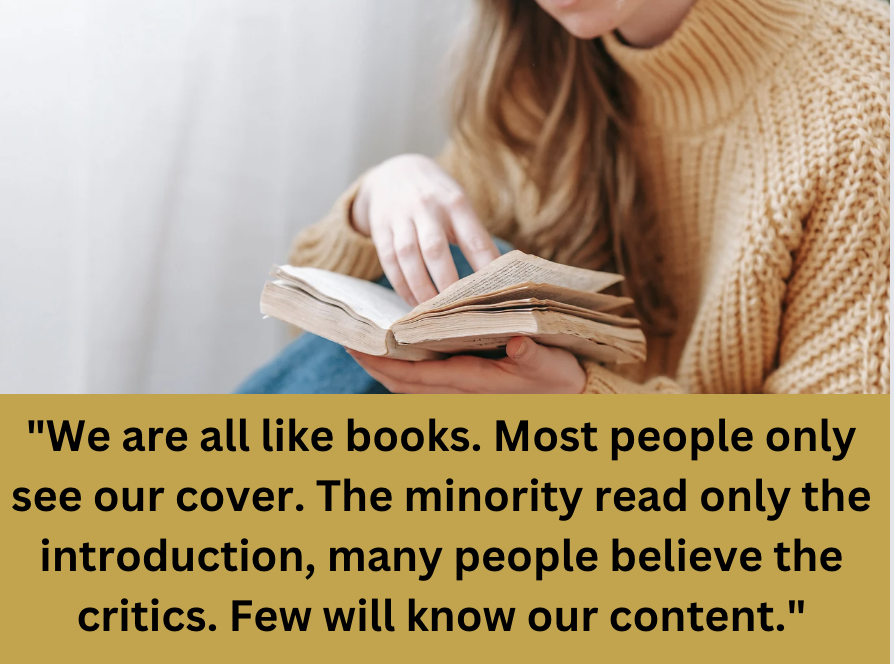
“We are all like books. Most people only see our cover. The minority read only the introduction, many people believe the critics. Few will know our content.”
It made me smile because there is something wonderfully human in it. We meet one another through covers.
Appearances. Behaviours. Personalities. Roles. Reactions. Stories.
The version of someone we think we know and yet beneath the cover of every human being exists an extraordinary inner world — history, emotion, conditioning, sensation, memory, desire, fear, imagination, energy, consciousness, spirit and ways of perceiving life that another person may never completely know.
Perhaps one of the great gifts of relationship is that another human being gives us an opportunity to discover more of that world within ourselves.
Relationship as a Mirror
Self-discovery can sound like a solitary pursuit. We imagine ourselves meditating on a mountain, journalling, contemplating life or disappearing on retreat to “find ourselves.”
And all of those experiences can offer beautiful opportunities for inquiry.
Then we come home and someone we love says the wrong thing in exactly the wrong tone, and suddenly there we are.
There is the practice.
Relationship has an extraordinary capacity to reveal us. What opens us. What contracts us. What we protect. What we long for. What we assume. What we fear. What we expect another person to provide. The places where we feel free and the places where an old reflex can take over before awareness has even entered the room. None of this needs to mean something has gone wrong. It is information.
The mirror is showing us something.
Two Inner Worlds Meet
Every relationship brings together more than two personalities. Two histories meet. Two nervous systems. Two sets of conditioning. Two emotional landscapes. Two bodies of lived experience. Two ways of perceiving and interpreting the world., through another lens, two energetic expressions of life. Each person is experiencing the relationship subjectively while simultaneously becoming part of the other's environment.
This is where relationship becomes multidimensional.
There is me.
There is you.
And there is also what is being created between us.
A relational field begins to form through our words, attention, expectations, touch, silences, reactions, presence, energy and choices.
We influence it and are influenced by it. Sometimes what moves between two people is obvious. Sometimes it is subtle. A shift in someone's body. A change in tone. A withdrawal. An opening. Something sensed before a word has been spoken. Our human instruments are continually communicating.
From Projection to Curiosity
Without awareness, it can be remarkably easy to make another person responsible for what is moving inside us.
You made me feel this. You should know what I need. If you changed, I could relax. Or perhaps we move in the opposite direction and make ourselves responsible for everything. Neither offers much freedom.
Self-discovery introduces another possibility - curiosity.
What is happening within me? What belongs to this moment, and what might be familiar from somewhere else? What is my body communicating? What story has my mind constructed? Is this an old protective response? What am I actually longing for? What am I afraid to reveal? Can I stay present long enough to discover what lies beneath my first reaction?
This doesn't mean denying another person's behaviour or abandoning our boundaries.
It means developing enough relationship with ourselves that we can begin to distinguish between what is happening, what we are experiencing, and what we choose to do with that experience.
This is self-governance in relationship.
Intimacy Begins Within
We often think intimacy is something another person gives us. But perhaps our capacity to be intimate with another is intimately related to our capacity to meet ourselves. Can I feel what I feel without immediately escaping it? Can I communicate desire? Can I allow myself to be seen? Can I hear another person's experience without automatically making it a judgement of me? Can I remain connected to myself while also being available to you? Can I meet difference without requiring sameness? Can I allow love, pleasure, tenderness and play to be as worthy of my attention as difficulty?
This last question matters.
Relationship work can become so preoccupied with what is wrong that we forget to become curious about what allows human beings to thrive together.
Connection.
Safety.
Freedom.
Touch.
Honesty.
Laughter.
Desire.
Play.
Creativity.
Repair.
Space.
Shared experience.
The willingness to keep discovering one another. These, too, deserve our attention.
The Relationship Becomes a Field of Creation
As awareness develops, relationship can become something more than a place where two histories continually react to one another.
It can become a place of conscious creation. Not because every reaction disappears. Not because two people reach some perfected state of consciousness. But because increasingly there is awareness within the process. I can notice myself. I can become curious about you. We can recognise what is happening between us and from that awareness, another response may become available.
Reaction can become response.
Defence can become curiosity.
Assumption can become communication.
Protection can make room for connection.
Inherited patterns can meet conscious choice.Something changes in the field between us and that matters beyond the relationship itself. The ways we love, listen, react, repair, parent, communicate and express ourselves ripple into families, friendships, communities and the environments we inhabit. From this perspective, the work of relationship is simultaneously personal, relational and collective.
How we meet one another becomes part of the world we collectively create.
Reading Beyond the Cover
Perhaps we never completely finish reading another human being. Perhaps we aren't supposed to. There will always be another page. Another chapter. Something we misunderstood. Something newly revealed. Something that changes. Something neither of us expected and perhaps that's part of the beauty.
True intimacy isn't knowing everything about another person. It is developing the capacity to remain curious enough to keep discovering. To read beyond the cover. To question the critics. To become aware of the stories we've written about one another. and to allow ourselves to be surprised by what is still unfolding.
Relationship then becomes more than somewhere we go to have our needs met.
It becomes one of the great environments in which we discover what it means to be human.
And occasionally, reflected in the eyes of another, we may glimpse something of ourselves we had never before been able to see.
Continue the exploration
Conscious Relationship
Intimate relationship can be one of our richest environments for human development — revealing our conditioning, emotional patterns, nervous-system responses, desires, protective strategies and capacity for love, intimacy, freedom and conscious creation.
Elevating Consciousness
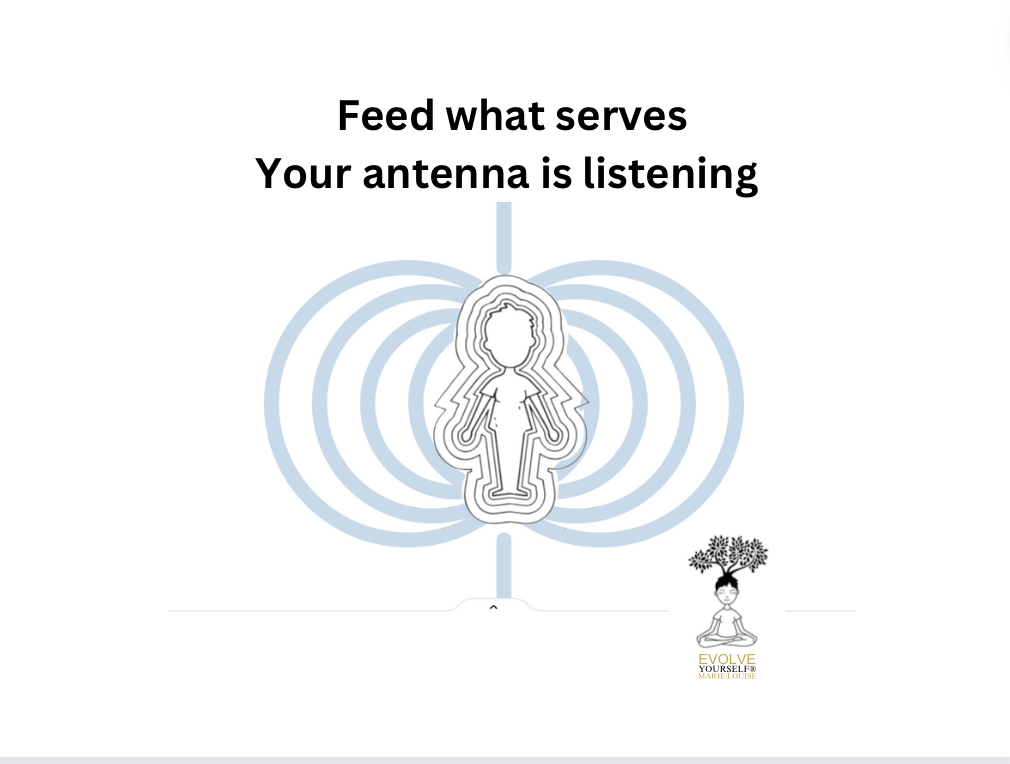
"The full spectrum of body/mind functioning vibrates at its collective frequency—the body/mind/spirit vessel, named YOU. I experience the human being not simply as an isolated physical organism, but as a multidimensional participant within a larger field of life.
We are subject and object. Individual and collective. We perceive the world through the particular organisation of our own human instrument, while simultaneously participating in and influencing the environments and relationships of which we are a part.
From this perspective, consciousness is not only something occurring privately “inside” us. Our actions, reflexes, attention, emotional states, choices and expressions enter the field in which we collectively live.
This is one of the conceptual lenses through which I explore human development: as the individual organism changes its relationship with awareness, what becomes possible within the collective also changes.
The often-told story of the “hundredth monkey” has been used as a metaphor for this possibility — the idea that when something shifts sufficiently within a group, a wider field of possibility may also shift. I don't need the story to function as scientific proof for it to remain an interesting contemplation.
Nature continually shows us that no organism exists independently of its environment. We influence and are influenced. We receive and transmit. We participate.
So I remain curious:
What am I contributing to the field through the way I am being?
Subjective — What am I experiencing?
Objective — What can we observe about the body, brain, nervous system, behaviour and environment?
Relational — What happens between organisms?
Collective — How do patterns, behaviours, ideas and ways of being propagate through groups and culture?
Universal / spiritual — What is the relationship between the individual expression of life and the greater intelligence or field of life itself?
Mystery — What can be experienced or contemplated without needing to be prematurely explained?
Perhaps this is another way of understanding responsibility, not as blame or burden, but as recognising that our expression participates in the whole.
'Discover Worlds Within' by Marie Louise

The art of process
The art of process, evolve yourself® with Marie Louise
What if life isn't asking us to arrive, but to participate?
There is an intelligence to process. We can see it everywhere in nature.
A seed contains possibility, but possibility alone does not make a garden. Soil matters. Water matters. Light matters. Timing matters. The environment matters and there is something within the seed itself that knows how to move towards expression.
Perhaps we are not so different.
Our lives are continually being shaped through the relationship between what is within us and the environments in which we live; our experiences, relationships, conditioning, attention, choices and the ways we respond to what life presents.
And within that relationship is something powerful:
Our capacity to consciously participate.
We Are Always in Process
Human development is often spoken about as though there is somewhere we are supposed to arrive.
A better version of ourselves. More healed. More evolved. More successful. More spiritual. More together.
But what if the invitation isn't to finally become finished?
What if it is to become increasingly available to the process of being alive? Our bodies are continually responding.
Our nervous systems are continually receiving information. Our emotions move. Our thoughts change. Our relationships reveal us. Our environments affect us. Life happens. And through all of it, something is continually being expressed, reorganised, discovered and created.
When we begin to pay attention to this movement, development becomes less about manufacturing a new self and more about developing a relationship with the human being already here.
Attention Is Part of the Environment
We often think of environment as something outside us; the room we live in, the people around us, the food we eat, the culture we inhabit.
But attention is also an environment. What we repeatedly give attention to influences what becomes familiar.
The stories we rehearse. The sensations we notice or ignore. The assumptions we continue to make. The possibilities we allow ourselves to perceive. This doesn't mean pretending everything is wonderful or using positive thinking to override what is actually happening.
It means becoming curious about the quality of attention we bring to our experience.
What am I nourishing?
What am I rehearsing?
What am I protecting?
What am I giving life to?
What might become possible if I brought awareness somewhere new?
Trust and Action
This is where the art of process becomes interesting. There is a dance between trust and action and subjective experience. Between listening and moving. Between allowing and choosing. Between recognising that life carries an intelligence of its own and recognising that we are not passive spectators within it. We participate. We can tend the soil. We can change environments. We can interrupt patterns. We can listen differently. We can choose where attention goes. We can become curious about our conditioning rather than unconsciously living from it. We can notice contraction without immediately making it wrong. We can act when action is called for and allow space when something needs time.
This is not control.
It is self-governance.
The capacity to be in relationship with what is moving through us while becoming increasingly conscious of how we meet it.
The Garden Doesn't Bloom by Force
There is something wonderfully humbling about a garden. You can create conditions that support life, but you cannot pull a flower open. You can water it. Feed the soil. Give it light. Protect it when necessary. Prune what no longer serves its growth. And then there is an element of allowing.
Human beings can be similar. Our fullest expression isn't necessarily something we have to force into existence. Perhaps part of our work is creating the conditions in which more of what is already alive within us can emerge.
Awareness.
Attention.
Movement.
Rest.
Relationship.
Play.
Curiosity.
Love.
Challenge.
Expression.
Food/thoughts/friends
All become part of the environment. And importantly, so do the difficult parts of being human.Process isn't only the beautiful blooming.It is also the compost.
The uncertainty.
The seasons when nothing appears to be happening.
The things that fall away.
The moments that ask us to meet ourselves differently.
Nothing in nature blooms continuously.
From Potential to Expression
Potential is an interesting word. We can spend our lives trying to reach our potential as though it exists somewhere ahead of us. But perhaps potential is not simply a destination. Perhaps it is something life continually invites into expression. A possibility becomes an action. An intuition becomes a choice. A feeling becomes communication.An idea becomes creation. An awareness changes a response.
Something once unconscious becomes visible, and suddenly another possibility exists.
This is where process becomes practice and practice becomes expression. Not through perfection.Through participation.
Get Your Skin in the Game
We don't learn the art of process only by understanding it intellectually. We experience it through
Our bodies.
Our relationships.
Our reactions.
Our creativity.
Our choices.
Our grief.
Our joy.
Our resistance.
Our desires.
Our willingness to begin again.
The human organism becomes both the instrument and the place of inquiry and perhaps that is part of the extraordinary opportunity of being alive: to become curious about the life moving through us, to participate consciously in its unfolding, and to create the conditions in which more of our innate nature can find expression.
This is an invitation to tend the garden. Give attention to the soil. Notice what you're feeding. Pull a weed occasionally. Plant something wildly optimistic. Leave some room for things you didn't plan and trust that not every stage of becoming needs to look like a flower.
You are not a finished product.
You are life in process and there is an art to participating in what wants to bloom.
Continue the exploration
Discover Worlds Within is an experiential exploration of the human organism — body, mind, emotions, energy, nervous system, spirit and consciousness — and what becomes possible as we develop greater awareness of the life moving through us.

5 Reasons Tuning Into Joy is a Tonic for Wellness
5 reasons joy is a tonic of wellness with Marie Louise
In the pursuit of wellness, we often focus on physical health, diet, and exercise, but we may overlook the profound impact attention to Joy can have on our overall well-being. Joy isn't just a fleeting emotion; it's a state of being that can positively influence our mental, emotional, and physical health. We have the ability to cultivate the environment in which joy can thrive with attention. Here are five compelling reasons why tuning into joy can be a powerful and potent tonic for wellness.
Boosts Immune System:
Research has shown that positive emotions, such as joy, can enhance the function of the immune system. When we experience joy, our bodies release neurotransmitters like dopamine and endorphins, which have been linked to strengthening the immune response. Regularly tapping into feelings of joy can help bolster our body's defenses against illness and promote overall health.
Reduces Stress and Anxiety:
Joy has a remarkable ability to counteract stress and anxiety. When we experience joy, our bodies naturally relax, and stress hormones like cortisol decrease. By intentionally cultivating moments of joy through activities we love or spending time with loved ones, we can create a buffer against the negative effects of stress, leading to greater emotional resilience and a calmer state of mind.
Enhances Mental Clarity and Creativity:
Joy has a way of clearing the mental fog and enhancing cognitive function. When we're joyful, our minds are more open, creative, and receptive to new ideas. This heightened mental clarity can lead to increased productivity, problem-solving abilities, and a greater sense of purpose and fulfillment in our daily lives.
Improves Relationships:
Joy is contagious, and when we radiate joy, it can positively impact the people around us, strengthening our relationships and social connections. Joyful interactions foster empathy, compassion, and understanding, creating a supportive environment where communication flows more easily, conflicts are resolved more peacefully, and bonds are deepened.
Promotes Overall Well-being:
Consciously choosing to give attention to things that make you joyful invigorates the pathways of joy in your brain to become the new automated response to life. In neuroscience, it's said that "neurons that fire together wire together." By consciously firing and wiring moments of joy, this neural feedback becomes the new norm. Conversely, feelings of the critic and judgment bias often create a deep reflex of toxic biochemistry and, if played long enough, can become heavy and depressing. Imagine the transformative effect of firing and wiring moments of joy into your neural pathways, creating a default state of positivity and resilience.
Cultivating our ability to attune and give attention to the things that make us feel good is by far one of the greatest gifts we can give to ourselves and the world around us. It isn’t always easy to see the good around our world, but with a little awareness, it might be worth the effort. So, here is the invitation to give wellness a crack and let your experience of doing so raise new evidence that you are worthy of your own attention. Let's make joy a priority and embrace its transformative effects on our exploratory and open wellness journey.
Author
Evolve Yourself® with Marie Louise
Marie Louise is a seasoned facilitator of wellbeing processes and activations, having positively influenced the lives of thousands of individuals across the globe. With a profound understanding of human nature and relationships, she has elevated countless individuals, enhancing their capacity to thrive.