

"Breaking Through - when relative truth becomes visible
Breaking free from mental noise
Understanding Limiting Beliefs and Their Impact
“There is nothing more confining than the prison we don’t know we are in. ”
There is nothing quite as convincing as a belief we don't know is a belief.
Once something has travelled with us for long enough, gathering experience and evidence along the way, it can stop feeling like an interpretation of reality and simply become reality. I'm not enough. There isn't enough. People like me don't do that. Money is difficult. Being seen isn't safe. Love requires me to give myself away. I couldn't possibly. That's just who I am.
Sometimes we don't even hear the words anymore. The belief has become part of the background hum, quietly participating in what we perceive, how we feel, the choices that appear available and the life we subsequently experience.
I think of these as relative truths.
They are not necessarily silly ideas we somehow picked up and now need to eliminate. Many of them made complete sense within the environments in which they formed. They may have arisen through experience, family, culture, relationships, things projected onto us, conclusions we made when we were young, or circumstances in which a particular way of seeing ourselves and the world helped us belong, protect ourselves or simply make sense of what was happening.
The relative truth can become woven into the organisation of the person until we are no longer simply thinking it. We are perceiving through it. This is why I've become less interested in the idea of “getting rid of limiting beliefs.” It is very easy to turn the belief into another thing that is wrong with us, another pesky piece of conditioning standing between us and the glorious expanded human we're supposed to become.
I'd rather get curious.
If something keeps appearing in our lives, a familiar relationship dynamic, a financial ceiling, a contraction around visibility, the inability to receive, a repeating emotional response, a place where we continually retreat despite consciously wanting to move forward, there is information there.
A question I use often in this work is:
What would I have to believe to be true for this experience or response to make complete sense?
It is a beautifully revealing question because it doesn't begin by assuming that our response is irrational. For a moment, we allow that there may be an internal logic to what is happening.
If being visible has become associated with rejection, of course some part of the organism may contract when visibility arrives. If receiving became tangled with obligation, consciously wanting abundance doesn't necessarily mean the whole instrument experiences receiving as safe or desirable. If love became associated with keeping everybody happy, saying no can carry far more energetic weight than the two letters would suggest.
Within that particular organisation of reality, the response makes sense. Once a belief begins to reveal itself, I like to play with the word true.
Is it true?
If the immediate answer is yes, and often it is, I become interested in the evidence. What experiences tell me this is true? Where have I seen it? How has life confirmed it?
Then I turn the lens slightly.
Have there ever been experiences in my life where this has not been true?
Even one?
Has there been a person, moment, relationship, opportunity or experience that doesn't quite fit inside the belief?
If there has, something interesting happens. We don't need to declare the belief false, but we can no longer hold it quite so easily as an absolute truth.
Then we can widen the lens again. Is this true for everyone? Does every human being experience this reality in the same way? If someone else can experience something differently, then what we are holding cannot be universally true.
It may still be very true for us. and that distinction is enormous.
Our lived experience doesn't suddenly become invalid because somebody else has had a different one. If someone has repeatedly experienced rejection, scarcity, abandonment, betrayal or not being heard, telling them “that's only a belief” completely misses the point. Those experiences happened. What we are exploring is the meaning that became organised around them and whether that meaning has subsequently become a lens through which future experiences are perceived.
Now we can ask something slightly different:
What would I have to believe for this to be relatively true for me? This is often where we begin travelling beneath the surface story. People always leave may reveal something closer to I'm not worth staying for. There's never enough money may open an entirely different conversation about safety, receiving, deserving, family history or what we learned was possible for people like us. I can't speak in front of people may have remarkably little to do with speaking and quite a lot to do with what being visible has come to mean within the instrument.
Once we discover the belief, we don't need to race off and replace it with a shinier one.
This is where some approaches to beliefs have never quite satisfied me. We can discover I am not enough, dutifully replace it with I am enough, repeat it every morning while brushing our teeth and still find that the body has apparently not received the memo. Because the organisation may not exist in words alone.
A belief can have a physical life, an emotional life, an energetic tone. It can participate in where attention goes and what we notice. It can influence the images we create, the possibilities we dismiss, the people we choose, what we expect from them and how we interpret their behaviour. This is where we put our skin in the game.
Rather than only asking what we believe, we can become curious about what believing it feels like.
Where does it live in the body? What happens to breath? Does something contract, rise, become heavy, numb, charged or restless? Is there an image? A memory? An impulse to move? Does the body want to pull backwards, push forwards, disappear, protect, speak, cry, run?
We don't have to decide immediately what any of it means. Sometimes the intelligence of the experience becomes clearer when we resist the urge to explain it too quickly. The body might reveal something the story hasn't.
An emotion can arrive that wasn't expected. An image appears. Breath changes. A sentence comes out of our mouth and suddenly we actually hear what we've been saying for years. Something previously fused into this is just who I am becomes visible as a pattern within the instrument, and that visibility changes our relationship with it.
This is where consciousness becomes very practical for me. We have this extraordinary capacity to become aware of what has been operating through us. Something that was once the lens through which we looked becomes something we are now capable of looking at, feeling and entering into relationship with. There is often momentum already moving within the pattern by the time we become aware of it.
This is where emotional maturation becomes particularly interesting.
Something happens and energy moves. We feel the charge, contraction, heat, fear, anger, agitation, grief or whatever form the experience is taking. Historically that momentum may have had a very familiar destination: withdraw, attack, please, freeze, hide, overperform, control, abandon the idea, silence ourselves. The momentum and its expression have become so familiar to one another that they can appear to be the same thing.
They aren't necessarily.
When we can connect to the momentum of the energy in its isness, without immediately suppressing it, naming it into a fixed story or allowing the old reflex to decide where it must go, another possibility becomes experientially available.
We can move with it.
We can breathe actively with it.
We can give it sound.
We can bring attention directly into its movement and allow attention to meet intention.
We can discover what happens when the same energetic momentum is given another pathway through the instrument.
This isn't about turning anger into love because love is spiritually superior, or convincing ourselves that fear is secretly joy. The raw experience deserves more respect than that. What we're developing is the emotional maturity and internal capacity to remain with the movement long enough to discover its intelligence.
Anger may contain power, clarity or the impulse for a boundary. Fear can contain an extraordinary amount of life and activation. A contraction around visibility may be carrying a younger intelligence that once understood hiding as protection. Grief can move through breath, sound or the body and reveal something that thinking about grief never touched.
The energy itself becomes material.
This is where the metaphor of alchemy becomes very tangible.
Steel to gold.
Not because steel was wrong.
Not because gold is “higher.”
The alchemy is in discovering that the raw material we thought could only express itself in one form contains other possibilities when awareness, movement, breath, attention and intention participate. This isn't something reserved for a particularly evolved few. It is an experiential availability of the human instrument. We already have the apparatus. We feel, perceive, move, breathe, imagine, direct attention, create meaning and express. The practice is developing a more conscious relationship with those capacities.
This is also why intellectual understanding remains important but isn't the whole story. We can understand a belief beautifully and still be living it. When understanding begins to move through sensation, emotion, energetic experience, behaviour and relationship, something else starts to happen.
It marinates and the development when it eventually appears in life.
Someone who has spent years understanding why they don't speak begins to use their voice without having to perform courage first. A person notices that the relationship dynamic that once swallowed them whole is happening again, but this time they remain connected to themselves inside it. An opportunity appears and the familiar contraction is still there, yet it no longer automatically means no. Creativity that has been held behind an old relative truth starts finding form.
This is where the experiential development becomes form. The old pattern may still exist. We don't need to ceremonially evict it from the psyche. But it is no longer the only reality available and it most definitely moves from a reflex to a choosing and hat changes what we can perceive.
Our beliefs participate in the images we project into life. If we are organised around an expectation of rejection, rejection may become particularly easy to see. If our internal architecture says there isn't enough, we may continually interpret the world through lack. What we hold as true influences what receives our attention, and what receives our attention influences how we respond. Our responses then participate in what happens next, and what happens next can conveniently become more evidence for what we believed in the first place.
Round and round we go. A relative truth can become a remarkably convincing reality when we've been helping to reproduce its evidence for years. This isn't blame. It is where response-ability begins to become exciting.
If awareness allows us to perceive the loop, then we have somewhere new to stand within it. We can recognise what has shaped us while also becoming curious about what else is available now and perhaps this is where my understanding of “breaking through” has changed.
I don't imagine us smashing through the walls of our conditioning anymore. There is something unnecessarily violent about trying to destroy architecture that may once have been constructed with considerable intelligence.Sometimes breaking through is much closer to seeing through and sensing new ways.
We see the relative truth. We discover what made it true for us. We recognise how it has organised itself through body, mind, emotion, nervous-system response, energetic movement and perception. We meet its momentum and somewhere within that meeting, the wall we thought was reality becomes something we can see. There is space around it. From there, something fresh has an opportunity to emerge rather than simply being prescribed by what happened yesterday.
This is where I experience our innate nature entering the conversation. Not as a perfect self hiding underneath all our messy conditioning, but as a deeper coherence carrying qualities of love, freedom, beauty, creativity, connection, curiosity and expression. As less of the instrument is occupied reproducing old relative truths, more of these qualities seem able to find form through the particular human being living the experience.
Our projection changes because the perceiver is changing. We see another possibility and, importantly, we can begin to experience another possibility. That distinction matters. Freedom isn't simply knowing that the wall isn't universally true. Freedom begins to become tangible when the organism discovers there is somewhere else it can move and once we've experienced that, even briefly, the old prison is never quite as invisible again.

The Alchemy of Self: Transforming Internal Energetics for Personal Growth
Transform your life with internal alchemy. Learn to shift outdated energetics through awareness and mindfulness for personal growth and self-improvement.
The Alchemy of Self
Alchemy has long been associated with the transformation of base metals into gold, yet there is another kind of alchemy available much closer to home. It takes place within the human instrument, in those moments when something that has been organising our experience becomes available to awareness and, through that meeting, is no longer required to remain in quite the same form.
Over many years of facilitating people through processes of human development, I have seen this happen in ways that can be subtle, immediate, surprising and sometimes quite profound. Someone may arrive wanting to understand a repeating relationship pattern, a fear around being seen, an emotional reaction that seems disproportionate to the moment, a contraction in the body, a belief they intellectually know is no longer true, or simply that familiar frustration of arriving at the same place despite understanding exactly how they got there.
We can know a great deal about ourselves and still find ourselves living the pattern. Intellectual understanding matters. Recognising where a belief or behaviour originated can create significant movement and give us a completely different relationship with our history. But there are times when the knowing hasn't yet travelled through the whole instrument. We understand something in the mind while the body, emotions or energetic organisation continue to respond according to something learned long ago.
This is where internal alchemy becomes interesting.
Our responses to life are not created through thought alone. The brain and nervous system participate, certainly, but so do sensation, emotion, memory, belief, perception, physiology, relationship and the energetic organisation of the person. Some patterns have been rehearsed so frequently that they have become familiar ways of meeting reality, while others seem to operate beneath conscious thought altogether.
We know them through their expression.
We hear ourselves saying the same thing again. We find ourselves choosing a familiar type of relationship. The body tightens in a particular situation. Our voice changes around a certain person. We become smaller, louder, pleasing, controlling, invisible or fiercely independent. We might consciously desire one thing while discovering that another part of the organism is moving in quite the opposite direction.
Rather than making these responses wrong, we can become interested in them.
What is actually happening here? What is moving through the body? What belief seems to accompany it? What does the organism appear to expect? Is there emotion, imagery, memory or an energetic quality attached to the experience? Does the response belong entirely to what is happening now, or has the present moment touched something familiar within us?
These aren't always questions that need immediate intellectual answers. In fact, one of the things I have witnessed repeatedly is that when we give the organism our attention without rushing to explain it, information can emerge through channels we might otherwise overlook.
A sensation moves. Breath changes. An unexpected emotion surfaces. An image appears. A memory that seemed irrelevant suddenly connects with something. We hear ourselves say a sentence we have probably spoken a hundred times before and, for whatever reason, this time we hear what is underneath it.
There can be a beautiful moment when something that has previously been fused into our sense of this is simply who I am becomes visible as an organisation or pattern within us. Nothing has necessarily disappeared, yet our relationship with it is already different because awareness is now participating.
This is one of the reasons attention plays such an important role in the work.
As we bring attention into the body, we become more sensitive to what is actually happening there. A contraction we might ordinarily rush to get rid of can become something we stay with for a while, not to indulge it or turn it into a problem, but to become curious about its composition. There may be emotion there, an old belief, an image, memory, energetic movement or simply a physical response whose intelligence becomes clearer through our willingness to listen.
Breath gives us another way of entering that conversation. In the processes of facilitation, Using the awareness and practices of breath is a powerful process of alchemy. Sometimes calm isn't what the experience is asking for. There may be anger that needs enough space to be felt, grief that has been beautifully contained, a boundary trying to find a voice, or excitement that feels remarkably similar to fear because expansion itself is unfamiliar.
At other times what emerges is harder to define. There may simply be movement, heat, charge, heaviness, vibration, contraction, spaciousness or a shift in the energetic tone of the experience. We don't necessarily need to hurry towards a label. As we breathe and remain present, we have an opportunity to experience what is happening before deciding what it means.
This is part of what I mean when I speak about internal energetics.
Being human is full of movement that we can feel directly. We experience contraction and expansion, vitality and heaviness, agitation and stillness, resonance, numbness, flow, charge. Some of these experiences can be understood through physiology and nervous-system function, others through emotion, psychology, memory and learned responses. Within my own work I also recognise energetics, consciousness and spiritual intelligence as dimensions of our experience, particularly when people begin perceiving information or movement that doesn't fit neatly within one explanatory model.
There is another part of this that I experience through the lens of emotional maturation: learning to meet the momentum of energy that is already here. Rather than immediately naming it, suppressing it, analysing it or allowing its familiar reflex to determine where it goes next, we can meet the energy in its isness — the actual movement occurring within the instrument now. This is where awareness becomes wonderfully practical. The charge itself can become material for conscious expression. Through movement, active breath, sound, attention moving into intention, or simply staying present long enough to feel what the energy is asking to do, we can discover that the momentum has more than one pathway available to it. What once moved automatically into anger may reveal power or a boundary; fear may contain an extraordinary amount of life waiting for movement; contraction may open into expression; grief may move through sound, breath or the body and reveal something we couldn't access by thinking about it. We are not pretending one emotion is another or trying to turn everything uncomfortable into something prettier. We are developing the emotional maturity to remain in relationship with the energy long enough for its intelligence to show us what else is available. This is experiential, and it is available to us through the very apparatus we are already living in. For me, this is where the steel-to-gold metaphor really earns its place: the raw material is not discarded; the same energetic momentum, met consciously, can find a different form of expression.
I don't feel the need to collapse these different dimensions into a single answer. We are multidimensional beings, and the richness is often in becoming sensitive to the conversation occurring between them.
A thought can change our breath. An emotion can move through the body. A shift in physical state can alter perception. Memory can arrive through an image. An energetic movement can reveal something before language catches up. Awareness itself can change our relationship with all of it.
The patterns within our body-mind organism can therefore be understood not as fixed objects but as living configurations shaped through genetics, experience, environment, relationships, beliefs, repetition, emotion, culture, conditioning and the countless ways life has moved through us. Some continue to support our expression beautifully. Others may still be organised around a reality that has passed.
Internal alchemy begins when those patterns become available to conscious relationship.
Not because the old pattern is bad and needs to be transmuted into something more attractive. If an organisation developed to protect us, belong, receive love or navigate an earlier environment, there was intelligence in its creation. We can honour that intelligence while recognising that what once served us may not be what we want organising our expression now.
This is where the alchemist gets to play.
We can feel what is happening rather than immediately escaping into explanation. We can breathe with it, move with it, listen to it and become curious about the beliefs or histories travelling alongside it. We can direct attention towards a different possibility and explore what qualities such as freedom, love, courage, creativity, receptivity or expression actually feel like within our own instrument rather than merely deciding that we would like more of them.
Years ago I used the phrase “I feel, I heal, I transmute.” There is still something in that language that I love, although my understanding of it has matured. Feeling isn't a guarantee of healing and not everything uncomfortable needs to become another personal-development project. What feeling can do is give us access to material that intellectual understanding alone may only circle around. It allows what has been organised within us to become part of our direct experience, where a different relationship with it becomes possible.
Sometimes change from that meeting is surprisingly quick. At other times it marinates.
The organism isn't a machine into which we insert awareness and receive transformation on demand. Some patterns soften through one very clear experience; others reorganise through repetition, relationship, attention and time. Different dimensions of us can also mature at different rates. We may comprehend something intellectually long before it becomes emotional knowing, embodied response or lived expression.
What matters to me is what eventually becomes visible in life.
Does someone who has spent years knowing they are worthy of being heard begin to actually speak?
Can we remain connected to ourselves in a relationship where we previously disappeared?
Does creativity that has been sitting behind fear begin finding form?
Can we meet a familiar situation and discover that the response that once seemed inevitable is no longer the only one available?
This is where alchemy moves beyond an interesting internal experience. Something has changed in the way we participate. To me, that is gold.
Not the elimination of discomfort or the creation of some permanently coherent human being floating blissfully above the messiness of life. Our humanity is far too magnificent for that.
The gold is greater availability.
More of the organism present to what is actually happening rather than automatically organised by what has happened before. More capacity to feel without being entirely driven by feeling, to think without every thought becoming truth, to listen to the body without making every sensation a problem, and to recognise energetic and intuitive information without abandoning discernment. As this relationship develops, we can become increasingly conscious participants in the way the instrument is tuned and this is where alchemy connects for me with our innate nature.
I experience something deeply coherent beneath much of the organisation we accumulate through life—not an untouched, perfect self hiding beneath our conditioning, but an intelligence carrying qualities that seem naturally inclined towards life: love, freedom, beauty, creativity, connection, curiosity, vitality and expression.
As some of the internal dissonance becomes integrated, those qualities can find a clearer passage through us. We don't have to manufacture them quite so forcefully. Their expression becomes more fluid because less of our energy is occupied maintaining an old configuration.
The image we project into life begins to refine accordingly.
The same world can be encountered through a different internal organisation, and therefore different possibilities become perceptible. We may see beauty where our attention once moved automatically towards threat, possibility where an old identity saw limitation, or another human being more clearly because we are no longer meeting them entirely through a history that belongs somewhere else.
That doesn't mean we create reality simply by thinking lovely thoughts. Life remains gloriously uncontrollable, and the full spectrum of human experience belongs here. It means that the instrument through which we perceive and participate in life matters.
And because none of us exists in isolation, what changes within us doesn't remain entirely within us either. Our internal organisation finds expression through voice, relationship, choices, creativity, touch, leadership, parenting, presence and all the subtle ways human beings influence one another.
A different internal tone enters the room. Another person receives it. Something different becomes possible between us.
This is where individual alchemy begins touching the relational and collective field. We are influenced by the environments in which we live and, through our expression, continually contribute something back into them. As awareness changes the way we participate, the information we offer the field changes too.
Perhaps this is why the old image of the alchemist still speaks to me. The raw material was never something to discard.
Our conditioning, emotional responses, beliefs, bodies, histories, nervous-system patterns, energetic movements and even the parts of ourselves we have spent years wishing were different all contain information. When we learn how to meet that material with awareness, curiosity and enough capacity to stay in relationship with it, what once appeared to be the obstruction can become part of the intelligence through which we develop.
We don't throw away the base metal. We discover what else it can become and somewhere within that process, more of our innate nature becomes available to move through the skin and take form in the life we are actually living.
Continue the exploration
Discover Worlds Within explores the human sleeve — body, mind, emotions, nervous system, energy, spirit and consciousness — and invites us to get our skin in the game, developing a lived relationship with the intelligence, conditioning and possibility moving within us.
Practical Steps to Internal Alchemy
Be Present to Your Body: Ground yourself in the present moment. This involves being aware of your body and its sensations.
Feel Your Bodily Sensations: Pay close attention to how your body feels. This might include noticing areas of tension, discomfort, or other sensations.
Breathe and Breathe Again: Deep, mindful breathing helps to calm the nervous system and brings more awareness to your current state, while gaining access to the mass of energetic internal happenings so you can consciously do something with them.
Direct Your Attention: Focus your attention on the areas of your life you would like to change. This conscious direction of your focus is where the alchemical process begins.
Exploring Internal Energetics
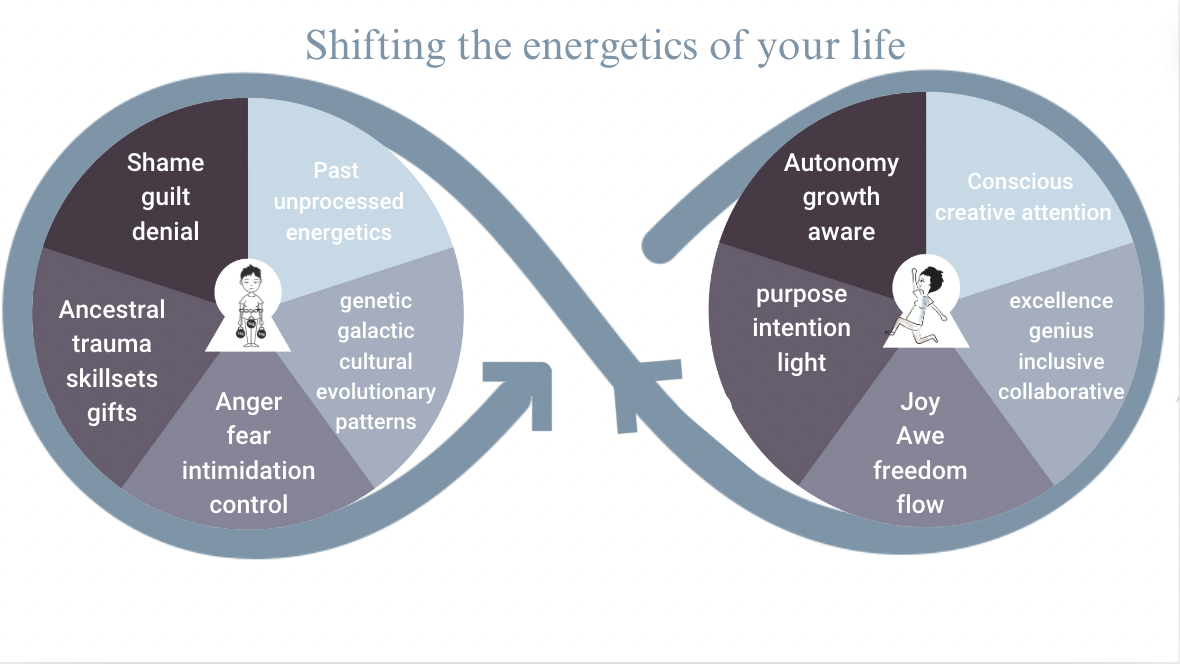
Looking at this image attached represents the patterns of internal energetics within our body/mind organism. This image can help you explore patterns within the skin and what they are made up of and direct those patterns that no longer serve you into new desires or qualities of change. By becoming present with your body, feeling your sensations, and consciously breathing, you create a space where you can direct your attention and life force towards transformation.
In essence, becoming aware of your reactions and beliefs, feeling deeply into your sensations, and consciously choosing where to direct your attention allows you to become an alchemist of your own life. This internal process of alchemy leads to profound personal transformation and the realisation of your highest potential.

#PersonalGrowth #SelfTransformation #InnerAlchemy #Mindfulness #SelfAwareness #EmotionalIntelligence #Neuroscience #MentalHealth #SelfImprovement #ConsciousLiving #HolisticHealth #Transformation #Wellbeing #MindBodyConnection #InnerPeace

Freedom - the inner child chat
Marie Louise explores inner child integration as an experiential process for developing greater freedom, coherence and access to the innate intelligence seeking expression through us.

Freedom — The Inner Child Chat
Freedom, is a very different thing when it moves from an idea into the skin.
This is one of the reasons I have such respect for inner child integration. I have taken many people through these practices over the years and there is something quite profound in watching what happens when a person meets an earlier aspect of themselves from the awareness they have available now. What can look almost ridiculously simple from the outside; closing the eyes, bringing an image or felt sense of the younger self into awareness, listening, speaking, allowing, perhaps offering love or reassurance, can create a very obvious movement in the person experiencing it.
You see it. Sometimes in the face, sometimes in the breath or the way the body suddenly occupies space differently. The voice can change. There can be tears, laughter, anger, softness, silence, or an unexpected piece of information that seems to arrive from somewhere beyond the conversation we thought we were having. I have watched and experienced people access an understanding through these processes that they have been trying to intellectually resolve for years, yet when it is perceived through the body, imagery, feeling and the wider field of their awareness, it has an entirely different quality. It becomes theirs.
This is where the process gets really interesting for me because I am not simply interested in revisiting what went wrong in childhood. I am interested in what becomes available now in processing.
We were extraordinarily receptive little beings. Before we had language sophisticated enough to explain the world, the apparatus was already receiving it. Genetics, biology, family, environment, culture, relationship, tone, touch, absence, approval, fear, love, expectation and projection were all part of the soup. We were reading the room long before we knew that was what we were doing, and the body-mind was making adjustments according to what it perceived was needed.
A child who discovers that being quiet creates harmony may become exquisitely good at quiet. Another learns that achievement creates attention. Another becomes funny. Helpful. Invisible. Fiercely independent. The one who needs nothing. The one who keeps everybody together. There is an intelligence in this that I don't want to make wrong. The mask that formed may have been a brilliant little piece of engineering for the environment in which it was created.
It is when we continue wearing it long after the environment has changed that things can get a little tight and this is where I experience the inner child not simply as wounded material from the past, but as a doorway into aspects of our nature that may have been constrained along with it. The freedom to play, to imagine, to receive, to be curious, sensual, expressive, ridiculous, tender, creative, noisy, quiet, wildly interested in a beetle for twenty minutes, whatever belonged naturally to that particular being before the editing became so efficient.
When an integration process touches this territory, there can be a fluidity that returns which is quite beautiful to witness. It isn't necessarily dramatic. A person may simply begin expressing themselves with less effort. They might speak more directly, receive affection differently, become more playful, find themselves creating again, or realise they no longer need to perform the familiar role that has organised their relationships for years. This is the development that interests me: not simply having an insight in the process itself, but seeing the fruits of it appear later in the way someone actually lives.
There is an intelligence revealed through this that I find difficult to reduce to one mechanism, and I don't feel the need to. The psyche participates, the body participates, memory and imagination participate, our neurological and physical reflexes participate, and so do the energetic and spiritual dimensions of experience. Sometimes the perceiver knows exactly what has shifted and can articulate it beautifully; other times something has simply moved and the meaning arrives later.
The experience itself has intelligence.
Perhaps this is also why I experience our innate nature as coherent. Not perfect, polished or permanently peaceful, but coherent in the sense that when more of the instrument is available to itself, its expression becomes less distorted by all the energy required to maintain old protection. There is more room for the finer images of our nature to find form; love, beauty, creativity, freedom, connection, curiosity, generosity, play. They begin to appear not because we have pasted them over the uncomfortable parts of ourselves, but because the organism has more freedom to express them and what we hold within inevitably colours what we project into life.
If I am organised around an old expectation of rejection, that expectation will participate in the images I perceive and the way I meet people. If I have learned that being seen is dangerous, I can consciously desire visibility while another part of the apparatus quietly keeps pulling the curtains closed. When that younger organisation is finally met, listened to and included rather than overridden, the projection can begin to change because the perceiver has changed.
The world may be exactly where it was yesterday, but suddenly there is another image available.
That is a form of freedom experiential understanding opens through the experience of practice.
It is also why the practices around inner child integration don't have to be terribly serious. Play is potent. Creativity is potent. Nature, movement, laughter, imagination, meditation, giving ourselves permission to be beginners again, all of these can nourish parts of the instrument that adulthood has sometimes squeezed into very sensible little boxes.
I love observer meditation for this reason. It allows us to notice that we can witness what is moving without immediately needing to become it or change it. Inner child meditation brings another quality again because we deliberately enter relationship. I might invite someone to see themselves at a particular age, notice what arises without scripting it too quickly, and begin a conversation. How would you speak to this child? What tone would you use? What happens when you offer encouragement, protection, permission or simply your presence? What does the child show you?
Often the most profound part is not what we tell the child but what we receive back. That is where the chat becomes a two-way street. It becomes a physical shift and the anatomy changes because of what releases or is exposed.
The adult has perspective and resources that weren't available then, while the younger self can carry qualities and information the adult has lost contact with. Integration allows those worlds to meet, and I have watched that meeting create an extraordinary shift in how a person perceives themselves and subsequently participates in life.
Maybe that is why I don't see inner child work as continually returning to the past. Done well, it seems to do almost the opposite. It releases energy for the present and the nurturing quality that opens up for the iindividual supports maturation of previous story/experience.
There is less effort required to keep the old architecture standing and more life available for what wants to move now.
More of the innate nature gets through and when love, freedom, beauty, creativity and the peculiar genius of an individual human being are given a clearer passage through the instrument, they don't stay inside the skin. They become choices, relationships, creations, conversations, environments and the images we offer back into the collective field.
We aren't only tending the child we were. We are giving greater freedom to the human being we are here to express.
Have fun exploring.
Continue the exploration
If you want to take the inner-child inquiry beyond an idea and into your own human instrument, Discover Worlds Within explores the body, mind, emotions, nervous system, energy, spirit and consciousness through which we experience and express life.
Explore Discover Worlds Within →
Continue the exploration
Discover Worlds Within
Discover Worlds Within explores the human sleeve — body, mind, emotions, nervous system, energy, spirit and consciousness — and the conditioning, intelligence and possibility that participate in the way we experience and express life.
An invitation to understand what has shaped you while becoming increasingly available to what wants to move through you.
Explore Discover Worlds Within →

Lean in, breath in
Marie Louise explores dissonance as information and the possibility that breath, embodied awareness and curiosity can open space between our familiar reflexes and what we choose to express next.
What if the subtle niggle isn't something to get rid of, but something worth getting curious about?
There is that moment when something hits. A comment. A look. A conversation that suddenly takes a turn. An opportunity you have been asking for finally arrives and, instead of throwing your arms in the air with excitement, something inside you contracts and whispers, Oh shit. The body has entered the conversation.
Sometimes long before we've consciously worked out what the conversation is about. A tightening in the chest, a shift in breath, a knot in the belly, heat moving through the skin, an urge to explain yourself, defend, retreat, blame, fix, shut down or get the hell out of there. The movement can be enormous, or it can be so subtle that we barely notice it before the mind has swept in with its interpretation of events.
This is bad. They shouldn't have said that. I can't do this. Here we go again and off we go. I find this little meeting place fascinating. The place where life meets the instrument and the instrument responds.
I call what arises here dissonance. Not because it is inherently wrong, negative or something we need to clear from our system, but because something has moved out of its familiar hum. There is friction. A rub. Something in the field of our body-mind has been activated and is communicating. The question for me has become less How quickly can I make this feeling go away? and more:
What if I lean in?
Not recklessly. Not overriding the intelligence of fear, ignoring boundaries or forcing myself into experiences that don't feel right. Leaning in isn't another cleverly disguised way of bullying ourselves into growth. It is simply an invitation to become curious.
Before the Story Gets Its Pants On
Our human organism is wonderfully quick. Something happens and biology, memory, emotion, nervous-system response, conditioning and whatever else is humming through the instrument can be in motion before our conscious mind has even located the car keys. Then along comes interpretation and interpretation matters. The mind is part of this extraordinary apparatus too. It helps us make meaning, discern, understand, imagine, remember and navigate our world, but sometimes the mind is interpreting the present through material gathered somewhere else.
An old relationship.
An early experience.
Something we learned about ourselves.
A family pattern.
A previous rejection.
A belief we've rehearsed so often it no longer feels like a belief; it simply feels like reality.
This is where the invitation to be curious about the territory before the label. Before this is anxiety. Before this is rejection. Before you have made me feel this. Before the anger rises because...
What is actually happening in the skin? Tightness? Heat? Pressure? Tingling? Movement? A pull backwards? A rising force? A heaviness? Something expanding? Something wanting to get very, very small?
Can I be with that movement for a moment before I brand it? There is value in naming our emotions, of course. Language can illuminate and help us communicate what is happening within us. But there is also a delicious intelligence in allowing ourselves to feel before we explain. Sometimes the story is accurate.Sometimes it isn't. Sometimes the sensation itself has more to tell us before the mind turns it into a three-act drama and this is where I breathe.
Not because breath is some magical eraser of uncomfortable human experience. I'm not particularly interested in using breath to make myself calm so I can get back to being a “good” regulated human. I breathe because breath brings me into relationship.
Here.
Skin.
Sensation.
Movement.
What is actually happening?
Perhaps the breath changes something. Perhaps it doesn't. Perhaps the contraction becomes stronger for a moment. Perhaps tears arrive. Perhaps the body softens. Perhaps underneath what I thought was anger there is grief, and underneath the grief there is love, and underneath that there is something I don't have a bloody word for.
Good. We don't always need one.
Dissonance Has Its Own Intelligence
We've become rather fond of turning discomfort into something to overcome. Fear must be conquered. Blocks cleared. Negative beliefs replaced. Triggers healed. Resistance broken through, but what if dissonance is not necessarily the enemy of development? What if sometimes dissonance is development knocking at the door an old identity meets a new possibility and there is friction.
Desire meets protection. Love meets fear. Something wants to expand while another part of the organism has become exquisitely skilled at keeping life within familiar boundaries. Of course there is a rub. The body has history. The mind has history. Our emotional landscape has history. The nervous system has history and, through the energetic and spiritual lens through which we also could experience human life, there may be movements and resonances that don't fit neatly into any one explanatory box. We don't need to decide which dimension is the answer. We can be interested in their conversation. This is the multidimensional playground of being human.
Something can make complete sense intellectually and still bring the body to its knees. Something can shift in the body before the mind understands what has happened. A spiritual realisation can open an enormous field of perception and then Tuesday afternoon arrives and somebody says exactly the right thing to illuminate a reflex we thought we'd transcended three years ago. Welcome back to the skin.
This is where maturity marinates.
Understanding has to meet experience. Experience meets biology. Awareness meets conditioning. Relationship pokes at the bits we cannot see alone. The organism gathers new information, and sometimes—slowly, messily, beautifully—something reorganises.
The Tiny Gap Where Something New Can Happen
There is a delicious little moment, sometimes so bloody small we miss it, where something has landed, the body has responded and the mind is halfway through building its case for what just happened and somewhere in that mix, awareness can arrive.
Oh. Look at that. Something is moving in me. That is all. We don't need to immediately transform it.
The reaction may still come. We may still cry, speak, shake, leave, set a boundary, say no, say yes, ask for space, discover that the fear was extraordinarily intelligent or realise that an ancient reflex has just walked into a completely new situation wearing an old costume.
But now we are in relationship with the response rather than entirely being driven by it.
This is one of the places we can experience self-governance—not as self-control, but as developing such an intimate relationship with our own instrument that we begin to recognise what is moving through it and with recognition comes possibility. Not certainty but Possibility. Perhaps the old reflex still wins this round. That's okay too. Awareness has now met it. Something new has entered the field.
And It Doesn't Stop at Our Skin
This is where the inquiry becomes even more interesting, because nothing we express exists entirely in isolation.
If we meet dissonance differently, the expression we bring into relationship may also be different. Perhaps instead of immediately retaliating, we become curious. Perhaps instead of collapsing, we discover a boundary.
Perhaps instead of making another person responsible for everything moving through me, I can feel what belongs to me while still remaining clear about what belongs to them.
Perhaps a reflex that has travelled beautifully and efficiently through generations of our families meets awareness in the body and, this time, doesn't travel forward in quite the same form.
What happens then? A conversation changes. Someone else's body receives a different signal. A child witnesses another possibility. A relationship reorganises. A room has a different tone. This is where the subjective begins to touch the collective.
We are individual instruments, yes, but we are also continually entering one another's fields of experience. We influence and are influenced. Our states, choices, actions, language, touch, attention and reflexes become part of the environments other human beings inhabit.
Through a wider consciousness lens, Let’s remain curious about how far that influence travels. We don't need to pretend we know. The inquiry itself is enough to alter the quality of my participation.
Because if what I express contributes something to the field we share, even in the tiniest way, then getting curious about what moves through this skin becomes more than a private self-development exercise.
It becomes participation.
So, Lean In. Breathe In.
Maybe transformation doesn't always announce itself with fireworks and a life-changing revelation.Sometimes it is the subtle niggle. The breath you nearly didn't notice yourself holding. The flash of heat.The tightening jaw.The familiar story gathering momentum and that tiny flicker of awareness that catches it:
Hello. There you are.
Stay for a moment.
Breathe.
Feel before you fix.
Listen before you label.
Let the body have a word.
Let the mind have one too.
Let whatever energetic movement is present be part of the conversation and perhaps ask—not with an agenda to immediately change anything, but with genuine curiosity:
What is this showing me?
What is actually moving beneath the story?
Is this moment asking me to protect myself, express myself, soften, move, speak, wait, leave, stay—or simply feel?
And then perhaps the most interesting question of all:
What wants to move through me next?
Not what would the perfectly healed version of me do. Not what response earns me the highest consciousness badge. What becomes available here, in this actual body, in this actual moment, with the awareness I have now? Lean in.Breathe in. Get your skin in the game.
There may be far more intelligence moving through that subtle niggle than we first imagined.
Continue the exploration
Discover Worlds Within is an invitation to become curious about the extraordinary human sleeve — body, mind, emotions, nervous system, energy, spirit and consciousness — and the intelligence, conditioning and possibility moving through it.
Not simply to know more about yourself, but to experience yourself.

Level up or in
Marie Louise explores human development as a multidimensional process of maturity across body, mind, emotion, energy and consciousness, and asks how individual awareness participates in the collective.
Embark on a journey through the realms of consciousness, where each level offers a new vista of reality waiting to be explored. Where do you find yourself on this spectrum? Does your perception shift as you navigate through life's varied experiences?

Level Up or In?
What if human development is less a ladder of consciousness and more a multidimensional marination of maturity?
We have long been fascinated by the idea of levels.
Levels of consciousness. Levels of development. Higher states. Lower states. Awakening. Self-actualisation. Transcendence.
Abraham Maslow gave us one of the most recognisable maps of human motivation and development through what became known as the hierarchy of needs — moving through fundamental human needs towards self-actualisation, and in his later thinking, towards self-transcendence.
These maps can be useful.
They give the mind a way of comprehending something enormously complex. They offer us a vantage point from which to observe ourselves, recognise patterns and contemplate what else might be possible.
But a map is not the territory.
And I find myself increasingly curious about whether human development is adequately represented by a ladder at all.
What if we don't simply level up?
What if we level in?
Maturity Marinates
I have come to experience human development as something far less linear.
Maturity marinates. It takes place across multiple dimensions of the human experience, each continually informing and influencing the others.
Our genetics participate.
Our environment participates.
Our biology participates.
Our family and culture participate.
Our nervous system participates.
Our emotional experiences participate.
Our beliefs and conditioning participate.
Our relationships participate.
Our attention participates.
Our energetic experience participates.
Our spiritual inquiry participates.
And consciousness participates in our capacity to become aware of the whole extraordinary process. Rather than a series of neat developmental steps, I see something more like a living field of influence continually organising, adapting, responding and expressing itself through the human being.
Experience meets genetics.
Environment meets biology.
Conditioning meets awareness.
Relationship meets reflex.
Thought meets sensation.
The subjective meets the objective.
The individual meets the collective.
Consciousness meets form.
Somewhere within all of this, we mature. Not necessarily evenly, not necessarily predictably and certainly not in a straight line.
We Can Be Mature Here and Reflexive There
This multidimensional view helps explain something fascinating about being human. We can have extraordinary awareness in one area of our lives and find ourselves profoundly challenged in another. We may intellectually comprehend something for years and still discover that our body responds differently when the experience becomes personal. We may have expansive spiritual experiences and still encounter deeply conditioned emotional responses in relationship. We may demonstrate enormous professional intelligence and leadership while struggling to remain present with grief. We may understand the workings of the nervous system and still find ourselves in the middle of an automatic reaction before awareness catches up.
None of this necessarily represents failure or regression. It may simply reveal that different dimensions of us mature in different ways and at different times.
This is why I don't want to dismiss intellectual understanding in favour of embodiment, or embodiment in favour of spiritual experience, or scientific understanding in favour of intuitive knowing. I am interested in the relationship between them. Something can first be understood intellectually. Later experienced emotionally. Recognised physically. Encountered relationally. Perceived energetically. Contemplated spiritually and eventually something that we once knew becomes something we are increasingly able to live.
That is a very different idea of development.
The Human Sleeve
I sometimes call this multidimensional instrument our human sleeve.
The body, mind, emotions, nervous system, energy, senses, spirit and consciousness through which we experience and express life. We don't encounter reality independently of this instrument. We encounter life through an organism shaped by genetics, history, environment, experience, relationships, culture, memory, conditioning and the innumerable influences that have participated in our development and so our perception is not passive. The instrument participates in what is perceived. What one person experiences as possibility, another may experience as threat. What once contracted us may later become something we can remain present with. Something that was once completely outside our awareness may suddenly become visible. The external scene may not have changed at all, yet the internal organisation through which we experience it has.
A different experience of reality becomes available.
This is where consciousness becomes fascinating to me. Not simply as something we possess, achieve or elevate, but as the awareness through which we can begin to recognise the instrument itself and ability to express freely through it.
Subject. Object. Field. Awareness
There is another dimension to this inquiry. I am the subject of my experience and simultaneously, I become an object within yours. My body, words, actions, state, attention and expression enter your environment. Yours enter mine.
And when we come together, something else emerges: the field between us.
A relationship.
A family.
A room.
A community.
An organisation.
A culture.
A collective.
We influence these fields and are influenced by them.
Our nervous systems respond to one another. Behaviours are learned. Ideas travel. Language shapes perception. Emotional states can move through groups. Cultural patterns become normalised. Ways of responding can be passed from one generation to another and beyond what we can readily observe or measure, I remain interested in a larger conceptual and spiritual inquiry:
How does an individual shift in awareness participate in the consciousness of the collective?
I don't offer that as a conclusion. I offer it as a place from which to look.
The Hundredth Monkey and the Power of a Concept
There is a story often referred to as the hundredth monkey effect. In its popular telling, a new behaviour learned by a group of monkeys eventually reaches some critical threshold and somehow becomes available to monkeys elsewhere. The story has often been used to suggest the existence of a collective field of consciousness. As literal scientific evidence for such a mechanism, the popular version of the story does not hold up particularly well but I still find the concept interesting.
Because a concept does not need to masquerade as scientific proof to become a valuable lens for human inquiry. The hundredth monkey story invites me to contemplate:
What becomes possible within a collective when enough individuals begin perceiving, responding or behaving differently?
We already know through ordinary human experience that individual change does not remain entirely individual. A parent interrupts an inherited response and a child grows up inside a slightly different environment. One person refuses to participate in a familiar pattern and a relationship has to reorganise. Someone introduces a new idea and eventually an organisation speaks a different language. A generation questions something the previous generation accepted as normal and culture begins to move. One organism changes its expression. That expression enters the environment. The environment is now, however subtly, different. What happens next?
That question fascinates me.
Resonance as a Way of Listening
This is also where the language of resonance remains meaningful within my work. I experience the human being as having tone. Sometimes we feel coherent. Sometimes dissonant. Sometimes contracted. Sometimes expansive. Sometimes something resonates before we have language for why. We feel drawn towards something. Repelled by something. Opened. Closed. Energised. Quietened. Alive.
These experiences don't need to become a hierarchy of “high vibration” being good and “low vibration” being bad.
Dissonance itself may contain intelligence. A contraction may be communicating something. Fear may carry information. Grief may ask us to stop. Joy may show us something we hadn't been allowing ourselves to experience. Resonance, for me, becomes another way of listening to the instrument and experiential expression.
What is moving here?
What is this response communicating?
What am I resonating with?
What am I contributing?
What happens when awareness enters an automatic reflex?
And what becomes possible when the different dimensions of the organism begin to communicate more coherently?
Development Is Not an Escape From Humanity
This is where the idea of continually “leveling up” can become limiting. If higher always means better, we can inadvertently turn human development into another attempt to escape being human.
Move beyond the emotion. Transcend the body. Rise above the difficulty. Maintain the elevated state. But perhaps maturity sometimes moves in the opposite direction.
Down and in Into the body. Into the uncomfortable conversation. Into grief. Into pleasure. Into relationship. Into the unconscious response. Into the sensation beneath the story. Into the ordinary Tuesday afternoon when everything we thought we'd learned suddenly gets tested.
Spiritual expansion may open extraordinary dimensions of awareness. Intellectual comprehension can completely reorganise how we understand ourselves. Embodied experience can reveal something the intellect couldn't access through the tapping of experiential cognisance. Relationship can expose something meditation never touched.
Life can humble all of them.
Perhaps none needs to sit above another.
They are different dimensions and modes through which the human being can mature.
From Awareness to Expression
Utimately, I am interested in what awareness becomes when it enters life. If I experience an extraordinary state of consciousness but nothing changes in the way I relate, what has matured? If I understand compassion intellectually but cannot access it when someone challenges me, where is that understanding still marinating?
If I recognise an inherited reflex and, for the first time, choose something different, what has just become available?
This is where development becomes expression.
Not perfection.
Not arrival.
Not permanently inhabiting some elevated state.
But increasing availability.
More of the organism available to awareness.More awareness available within the organism.
More capacity to perceive.
More capacity to feel.
More capacity to choose.
More capacity to relate.
More capacity to create.
More capacity to express.
Perhaps this is what I mean by the fullest expression of being human.
Not becoming something above ourselves. Becoming increasingly available to the wholeness of our true nature.
And What of the Collective?
If we accept that human beings participate in one another's environments, then our development can never be entirely private. How I meet you becomes part of your experience. How I parent enters the developmental environment of a child. How I lead influences a room. How I respond to fear contributes something different from how I respond with curiosity. How I express love, judgement, creativity, aggression, tenderness, freedom or control enters the relational field around me and from my wider philosophical and spiritual lens, I remain open to an even greater possibility:
The great mystery unfolding to itself, as a participant and contributer on the expression of the cosmos Consciousness itself may participate in fields of relationship and influence that we do not yet fully comprehend. I don't need to know exactly where that inquiry ends.
The question itself changes the way I participate.
If my expression contributes something to the whole, what do I want to contribute?
So, Level Up or In?
Perhaps the answer isn't either/or. There may be moments of extraordinary expansion. Moments when consciousness seems to open beyond the boundaries of our familiar sense of self. There are also moments when life asks us to descend more deeply into the human experience.
To feel.
To listen.
To question.
To integrate.
To relate.
To embody.
To choose.
To express.
Human development may be less like climbing a ladder and more like marinating into maturity across the multidimensional field of ourselves.
Sometimes expanding. Sometimes contracting.S ometimes understanding. Sometimes unlearning. Sometimes resting. Sometimes reorganising. Sometimes discovering that something we thought we had mastered has another layer entirely and perhaps that's the beauty of it.
We are not trying to graduate from being human.
We are discovering what it means to inhabit our humanity more fully.
So, fellow explorer:
Where are you giving your attention?
Which dimension of you is asking to be listened to?
Where does your intellectual understanding want to become lived experience?
Where is dissonance carrying information?
What reflex is ready to meet awareness?
What quality are you bringing into the environments you inhabit?
And what might become possible in the collective when more of us become conscious of what we are contributing to it?
Maybe the invitation isn't simply to level up.
Maybe it is to level in, open out, and discover what becomes possible when more of the whole human being participates.
Continue the exploration
Discover Worlds Within
Discover Worlds Within is an experiential exploration of the human sleeve — body, mind, emotions, nervous system, energy, spirit and consciousness — and the ways these dimensions participate in how we perceive, experience, relate, create and express life.
It is an invitation not simply to understand yourself, but to get curious about the extraordinary instrument through which understanding becomes lived experience.

5 Reasons Tuning Into Joy is a Tonic for Wellness
5 reasons joy is a tonic of wellness with Marie Louise
In the pursuit of wellness, we often focus on physical health, diet, and exercise, but we may overlook the profound impact attention to Joy can have on our overall well-being. Joy isn't just a fleeting emotion; it's a state of being that can positively influence our mental, emotional, and physical health. We have the ability to cultivate the environment in which joy can thrive with attention. Here are five compelling reasons why tuning into joy can be a powerful and potent tonic for wellness.
Boosts Immune System:
Research has shown that positive emotions, such as joy, can enhance the function of the immune system. When we experience joy, our bodies release neurotransmitters like dopamine and endorphins, which have been linked to strengthening the immune response. Regularly tapping into feelings of joy can help bolster our body's defenses against illness and promote overall health.
Reduces Stress and Anxiety:
Joy has a remarkable ability to counteract stress and anxiety. When we experience joy, our bodies naturally relax, and stress hormones like cortisol decrease. By intentionally cultivating moments of joy through activities we love or spending time with loved ones, we can create a buffer against the negative effects of stress, leading to greater emotional resilience and a calmer state of mind.
Enhances Mental Clarity and Creativity:
Joy has a way of clearing the mental fog and enhancing cognitive function. When we're joyful, our minds are more open, creative, and receptive to new ideas. This heightened mental clarity can lead to increased productivity, problem-solving abilities, and a greater sense of purpose and fulfillment in our daily lives.
Improves Relationships:
Joy is contagious, and when we radiate joy, it can positively impact the people around us, strengthening our relationships and social connections. Joyful interactions foster empathy, compassion, and understanding, creating a supportive environment where communication flows more easily, conflicts are resolved more peacefully, and bonds are deepened.
Promotes Overall Well-being:
Consciously choosing to give attention to things that make you joyful invigorates the pathways of joy in your brain to become the new automated response to life. In neuroscience, it's said that "neurons that fire together wire together." By consciously firing and wiring moments of joy, this neural feedback becomes the new norm. Conversely, feelings of the critic and judgment bias often create a deep reflex of toxic biochemistry and, if played long enough, can become heavy and depressing. Imagine the transformative effect of firing and wiring moments of joy into your neural pathways, creating a default state of positivity and resilience.
Cultivating our ability to attune and give attention to the things that make us feel good is by far one of the greatest gifts we can give to ourselves and the world around us. It isn’t always easy to see the good around our world, but with a little awareness, it might be worth the effort. So, here is the invitation to give wellness a crack and let your experience of doing so raise new evidence that you are worthy of your own attention. Let's make joy a priority and embrace its transformative effects on our exploratory and open wellness journey.
Author
Evolve Yourself® with Marie Louise
Marie Louise is a seasoned facilitator of wellbeing processes and activations, having positively influenced the lives of thousands of individuals across the globe. With a profound understanding of human nature and relationships, she has elevated countless individuals, enhancing their capacity to thrive.